Sunday 12th April 2026 - Hell is Murky but Derby Theatre puts on a marvellous performance of Macbeth!
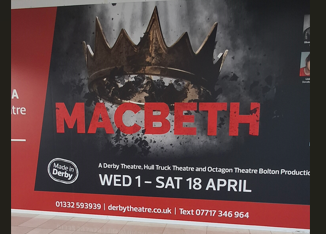
Last week, I went to see Macbeth at Derby Theatre, a collaboration between Derby Theatre, Hull Truck Theatre, and Octagon Theatre Bolton, directed by Mark Babych, and it was, quite simply, outstanding. I’ve seen countless productions of Macbeth, both nationally and locally, and this is undoubtedly one of the best.
Oliver Alvin-Wilson as Macbeth was exceptional. What stood out most was not just his vocal delivery, but the physical transformation he embodied on stage. You could see the trajectory from “brave Macbeth” to “hell-hound” in his posture, his movement, and his presence. It was a performance that fully captured the psychological and moral disintegration of the character.
Jo Mousley as Lady Macbeth was equally compelling. Her portrayal of manipulation and coercion was sharp and controlled, and I particularly loved the symbolic touches: the red cloak, the cardigan, and even her perfectly red pedicured nails. These were subtle but powerful nods to the motif of blood that runs throughout the play.
One of the most striking things about the evening was this: despite knowing the play so well, there were moments that felt entirely new. As teachers, we often “hear” the lines in our own heads, but this production disrupted that. Certain scenes and familiar quotations landed differently, and I’ve come away wanting to revisit them with fresh eyes. In particular, I found myself newly engaged by the political downfall at the end of the play. The roles of Macduff and Malcolm felt especially significant in this production, and their final scenes are ones I now want to return to and explore more deeply.
Banquo’s ghost was brilliantly realised. It was visceral, shocking, and unapologetically gory. The staging did not hold back, and the blood, the violence, and the physicality of the moment all added to the intensity. It was slightly undercut, admittedly, by spotting Banquo casually walking to his car afterwards, which is one of the hazards of local theatre. A special mention, too, for Ross, whose comic timing was perfectly judged and provided much-needed contrast within the production.
Perhaps most interestingly, this experience made me reflect on teaching. For years, my go-to Shakespeare texts have been Romeo and Juliet and The Merchant of Venice, which are still firm favourites. However, in the past five years of tutoring, Macbeth has become by far the most widely taught play. Watching this production reminded me exactly why. Its pace, its intensity, and its psychological depth grip students in a way few texts do. Even the modern elements, such as the use of guns, which can sometimes feel distracting, worked seamlessly here.
As a teacher, I’m always thinking about exam questions, and I think we very often focus heavily on Macbeth and Lady Macbeth’s ambition. We return again and again to key quotations like “vaulting ambition”, “hide not thy deep and dark desires”, and “stars, hide your fires”. These are, of course, central to understanding the beginning of Macbeth’s moral decline. However, what really struck me in this production was how powerful the end of the play is, particularly in terms of political instability and the collapse of order.
I revisited these quotations after watching the performance-
1. “Bleed, bleed, poor country!” (Macduff, Act 4 Scene 3)
This personification of Scotland presents the nation as wounded and suffering. It’s a powerful way of showing that Macbeth’s rule has damaged the entire country, not just individuals.
2. “Each new morn, new widows howl, new orphans cry” (Macduff, Act 4 Scene 3)
The repetition of “new” emphasises the ongoing, relentless suffering under Macbeth’s tyranny. It also shifts focus from the king to the people, which is often overlooked.
3. “Those he commands move only in command, nothing in love” (Angus, Act 5 Scene 2)
This emphasises how Macbeth’s power is hollow. People obey him, but there is no loyalty or respect. This is a clear sign of political instability.
Please do try to see a live performance of your set text if you can. These plays were never written to be studied at a desk, and students gain something far more visceral from seeing them performed. It brings the text to life and encourages them to think more deeply about staging, setting, and lighting, which can really elevate their analysis.
An absolutely superb production. Thought-provoking, visually striking, and a powerful reminder of why Shakespeare still feels so relevant on stage today.
